Scaling Micro-Transactions: Many-to-One Payout Batching inside Postgres
In a “No-Backend” architecture where the database is the primary application engine, writing clean and optimized business logic directly inside the database is key.
Recently, while building lagu-lagu—a stateless payout registry for independent musicians—we ran into a common micro-transaction scaling bottleneck: notary fee bloat.
If a fan tips an artist $1.00, triggering an outbound bank payout (via Tazapay) and committing a cryptographic proof to a public ledger (BSV Notary API) for every single transaction eats up all the artist’s micro-liquidity in network transaction fees.
The solution? Threshold Payout Batching implemented natively in Postgres.
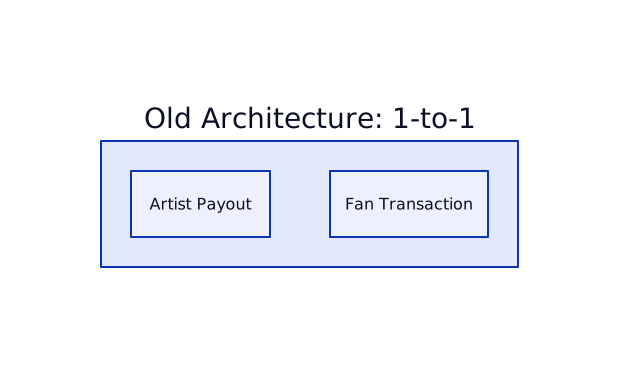
1. Shifting from 1-to-1 to Many-to-One Relations
Initially, our payouts table had a
transaction_id column with a UNIQUE
constraint. This enforced a strict 1-to-1 relationship between fan
payments and artist payouts:
To support batching, we inverted this relation. A single
payout can clear multiple incoming
transactions. The database structure became
many-to-one:

Architectural Comparison
| Feature | Standard 1-to-1 Payouts | Many-to-One Threshold Batched Payouts |
|---|---|---|
| Relationship Schema | payouts holds
transaction_id (Unique) |
transactions holds
payout_id (Nullable) |
| Notary Cost (BSV) | - Fee paid on every single transaction | - Fee paid once per threshold batch |
| Outbound Disbursals | Instant payout on every single stream/tip | Grouped payout once threshold (e.g., $10) is met |
| Integrity Enforcement | Hard database unique constraint | Cascade deletion & Set Null on payout removal |
In SQL, this is implemented by: 1. Removing the
transaction_id column from the payouts table.
2. Adding a nullable
payout_id UUID REFERENCES payouts(id) ON DELETE SET NULL to
the transactions table.
2. Natively Batching with PL/pgSQL Triggers
Instead of spinning up a background cron job (which introduces
latency and state drift), we use an AFTER UPDATE
row trigger in Postgres to calculate and batch balances on the
fly.
When a transaction status is updated to 'success', the
trigger calculates the current pending balance of all successful
transactions for the artist that have not yet been paid out:
CREATE OR REPLACE FUNCTION process_payment_split()
RETURNS TRIGGER AS $$
DECLARE
    v_artist_id UUID;
    v_pending_amount NUMERIC(12, 4);
    v_amount_sent NUMERIC(12, 4);
    v_commission_retained NUMERIC(12, 4);
    v_payout_id UUID;
    v_threshold NUMERIC(12, 4) := 10.0000; -- SGD 10.00 threshold
BEGIN
    -- Trigger split when transaction status updates to 'success'
    IF NEW.status = 'success' AND (TG_OP = 'INSERT' OR OLD.status IS NULL OR OLD.status != 'success') THEN
        -- Find the artist associated with the track
        SELECT artist_id INTO v_artist_id FROM tracks WHERE id = NEW.track_id;

        -- Sum all successful, unpaid transactions for this artist
        SELECT COALESCE(SUM(t.amount), 0) INTO v_pending_amount
        FROM transactions t
        JOIN tracks tr ON t.track_id = tr.id
        WHERE tr.artist_id = v_artist_id
          AND t.status = 'success'
          AND t.payout_id IS NULL;

        -- If the accumulated balance meets or exceeds the threshold, batch the payout
        IF v_pending_amount >= v_threshold THEN
            v_amount_sent := v_pending_amount * 0.80; -- 80% to artist
            v_commission_retained := v_pending_amount * 0.20; -- 20% commission

            -- Create a single grouped payout record
            INSERT INTO payouts (artist_id, amount_sent, commission_retained, currency, status)
            VALUES (v_artist_id, v_amount_sent, v_commission_retained, NEW.currency, 'pending')
            RETURNING id INTO v_payout_id;

            -- Update all pending transactions to point to this settling payout_id
            UPDATE transactions
            SET payout_id = v_payout_id
            WHERE id IN (
                SELECT t.id
                FROM transactions t
                JOIN tracks tr ON t.track_id = tr.id
                WHERE tr.artist_id = v_artist_id
                  AND t.status = 'success'
                  AND t.payout_id IS NULL
            );
        END IF;
    END IF;
    RETURN NEW;
END;
$$ LANGUAGE plpgsql;
3. The Stateless Proxy Loop
Because the database handles the complex state transitions and batching internally, the serverless API router (GCP Cloud Function / Cloudflare Worker) remains completely stateless:
- The payment gateway webhook sends a
successcallback to the GCP Cloud Function. - The function inserts the transaction into Neon Postgres.
- If the trigger finds the artist’s total pending balance is below the threshold, it commits the write and immediately returns a success message to the gateway (payout pending).
- If the threshold is reached, the database compiles the payout record
and returns the new
payout_id. The function detects this, calls the outbound Tazapay settlement API, submits a single Merkle notary proof on the blockchain, and commits.
Conclusion: Thermodynamic Software Engineering
By shifting the computational logic directly to Postgres constraints and trigger functions: * We achieve zero CPU overhead on the API proxy gateway. * We eliminate network transaction costs by times, ensuring micro-payments remain profitable for creators. * We preserve the single source of truth directly inside database relations.