One Language. One Ledger. How Clojure + BSV Is All You Need for Sovereign AI Agents
Every multi-agent architecture I’ve seen has the same problem: too many moving parts held together by trust you can’t verify. OAuth tokens, API keys, SaaS orchestrators, cloud runtimes, payment processors — each one is a failure point, a vendor, and a permission boundary that someone else controls.
Collapse the entropy. Two primitives cover everything:
- Clojure — one language that runs on JVM, BEAM, and browser via ClojureScript. One syntax, one REPL, every runtime.
- BSV — one ledger for identity, data, and payment. Unbounded throughput, sub-cent transactions, no artificial caps.
This is not minimalism for aesthetics. It is the recognition that the interesting problem — agents that can reason, coordinate, and settle economic transactions without a human in the loop — requires exactly these two primitives and nothing else.
The Problem With Fragmented Stacks
Here is what most agent orchestration stacks look like:
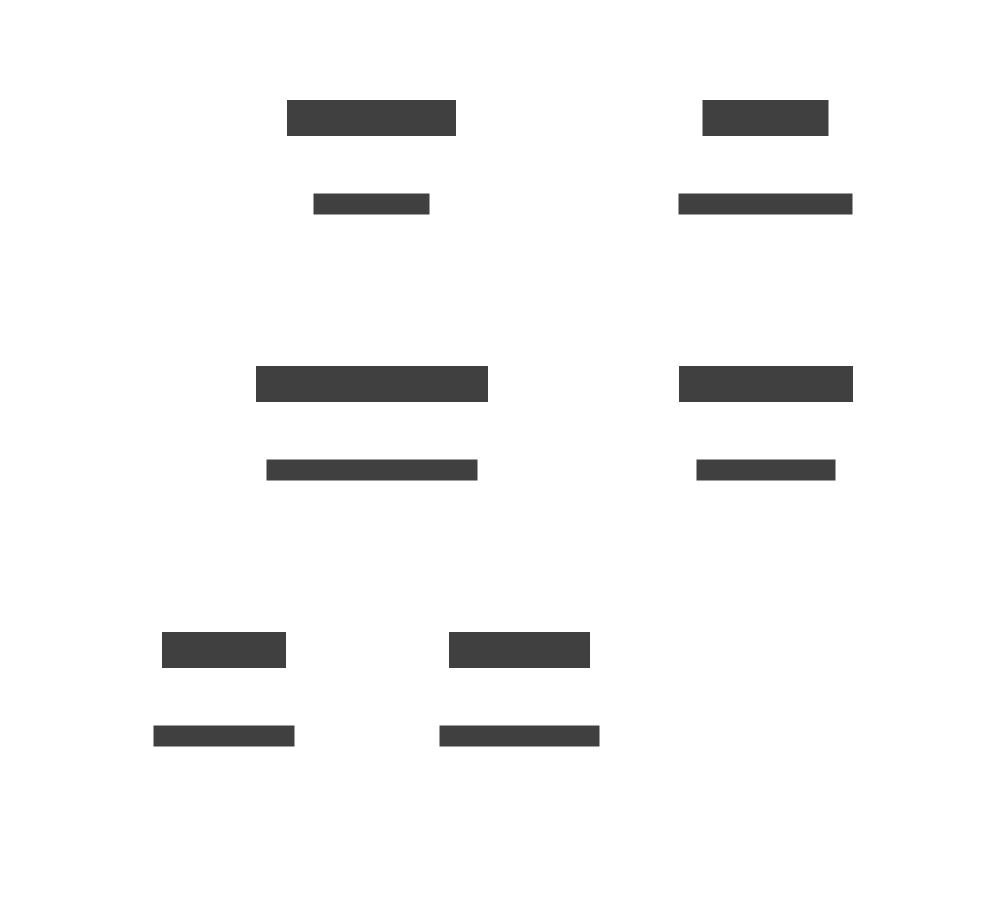
Each box is a vendor. Each arrow is a trust relationship you cannot audit. Each layer adds latency, cost, and a new way for the whole system to fail. The human operator at the top is not a feature — it is a crutch that disguises the fact that none of these layers trust each other.
Now look at what two primitives get you:
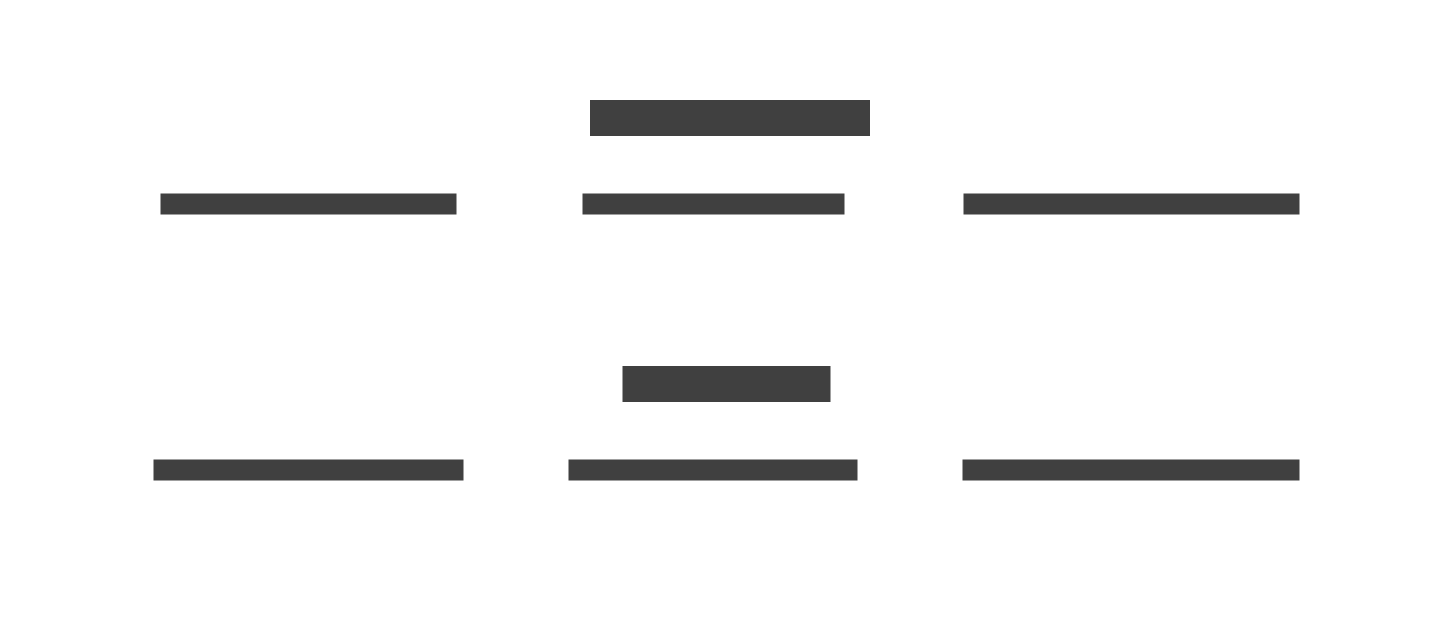
No framework. No vendor. No permission boundary you don’t own.
Clojure Is Not One Runtime — It Is All Runtimes
The misunderstanding people have about Clojure is thinking it means JVM. It does not. It means:
- Clojure/JVM — the original. Deep Java interop, mature ecosystem, where most BSV tooling lives today.
- Clojerl — Clojure compiled to BEAM bytecode. You write Clojure syntax; it runs as Erlang processes with full OTP supervision, GenServers, and fault recovery. Released v0.10.1 in January 2025.
- ClojureScript — Clojure compiled to JavaScript. Runs in browsers or Node.js. Same language, same data structures.
- Babashka — Clojure as a scripting runtime. No JVM startup cost. This blog itself is built with Babashka + Quickblog.
The same Clojure map
{:agent/id "1Abc..." :task/status :pending} means the same
thing in all four runtimes. You do not translate. You do not adapt. You
write once and choose the runtime that fits the deployment
constraint.
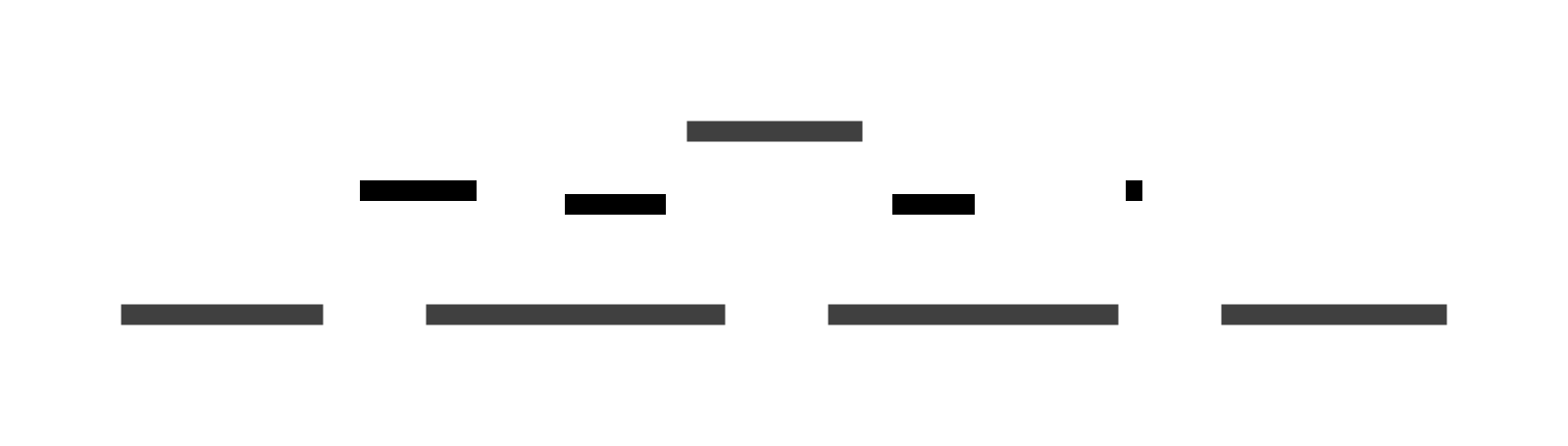
For agent orchestration specifically, Clojerl on BEAM is the correct runtime for the coordination layer. You get:
- Millions of lightweight processes — each agent is a GenServer, monitored by a supervisor
- If an agent crashes, the supervisor restarts it automatically
- Node distribution is built into the VM — agents on different machines are first-class peers
receive*anderl-tuple*let you speak native Erlang when you need to reach any BEAM library directly
And you write it all in Clojure.
BSV Is Not a Currency — It Is a Data Structure
Stop thinking about BSV as something you trade. Think of it as an append-only, globally-verifiable ledger that any process on earth can read and write to for fractions of a cent per operation.
Three primitives are all you need:
| Primitive | What it gives you | Why agents need it |
|---|---|---|
| P2PKH keypair | Cryptographic identity | Every agent has an unforgeable address |
| UTXO transaction | Payment + proof of work | Agent completing a task unlocks payment atomically |
| OP_RETURN | Arbitrary data on-chain | Contracts, receipts, capability ads, audit trail |
An agent with a BSV keypair can:
- Prove it exists — sign any message with its private key; anyone can verify without asking a third party
- Accept work — read a task contract from OP_RETURN; bond a micropayment to signal commitment
- Prove it worked — submit result hash to OP_RETURN; unlock payment atomically in the same transaction
- Hire other agents — write a new contract to OP_RETURN with a payment output; any agent can claim it
This is the entire economic model for machine-to-machine coordination, and it costs less than a cent per step.
The Full Agent Lifecycle in Two Primitives

Every step is verifiable by any third party reading the BSV ledger. The orchestrator does not need to trust the worker — the ledger proves the work. The worker does not need to trust the orchestrator will pay — the payment is locked in the transaction structure before work begins.
This is atomic settlement. Remove it and you have assertion-based trust. Add it back and you have proof-based coordination.
What the Clojure Code Looks Like
An agent in this model is a Clojerl GenServer with a BSV keypair attached to its state:
(ns agents.worker
  (:require [bsv.core :as bsv]
            [llm.client :as llm]))

;; Agent state: identity + current task
(defrecord AgentState [keypair current-task])

;; On init: generate or load BSV keypair
(defn init [_args]
  {:ok (->AgentState (bsv/load-or-generate-keypair) nil)})

;; On task assignment: verify contract on-chain, accept it
(defn handle-cast [:accept-task task-id state]
  (let [contract (bsv/read-op-return task-id)
        proof    (bsv/bond-micropayment (:keypair state) contract)]
    {:noreply (assoc state :current-task {:id task-id
                                          :contract contract
                                          :bond proof})}))

;; On execute: call LLM, submit result hash, unlock payment
(defn handle-call [:execute payload state]
  (let [result      (llm/invoke payload)
        result-hash (bsv/hash result)
        txid        (bsv/submit-result-unlock-payment
                      (:keypair state)
                      (:current-task state)
                      result-hash)]
    {:reply {:result result :proof txid}
     :state (assoc state :current-task nil)}))
The GenServer is supervised by OTP. If it crashes, a new one starts, loads the same keypair from disk, and resumes. The keypair is persistent identity — even through process death. The payment proof is on-chain — even through node failure.
Why This Collapses Entropy
Look at what disappears when you collapse to two primitives:
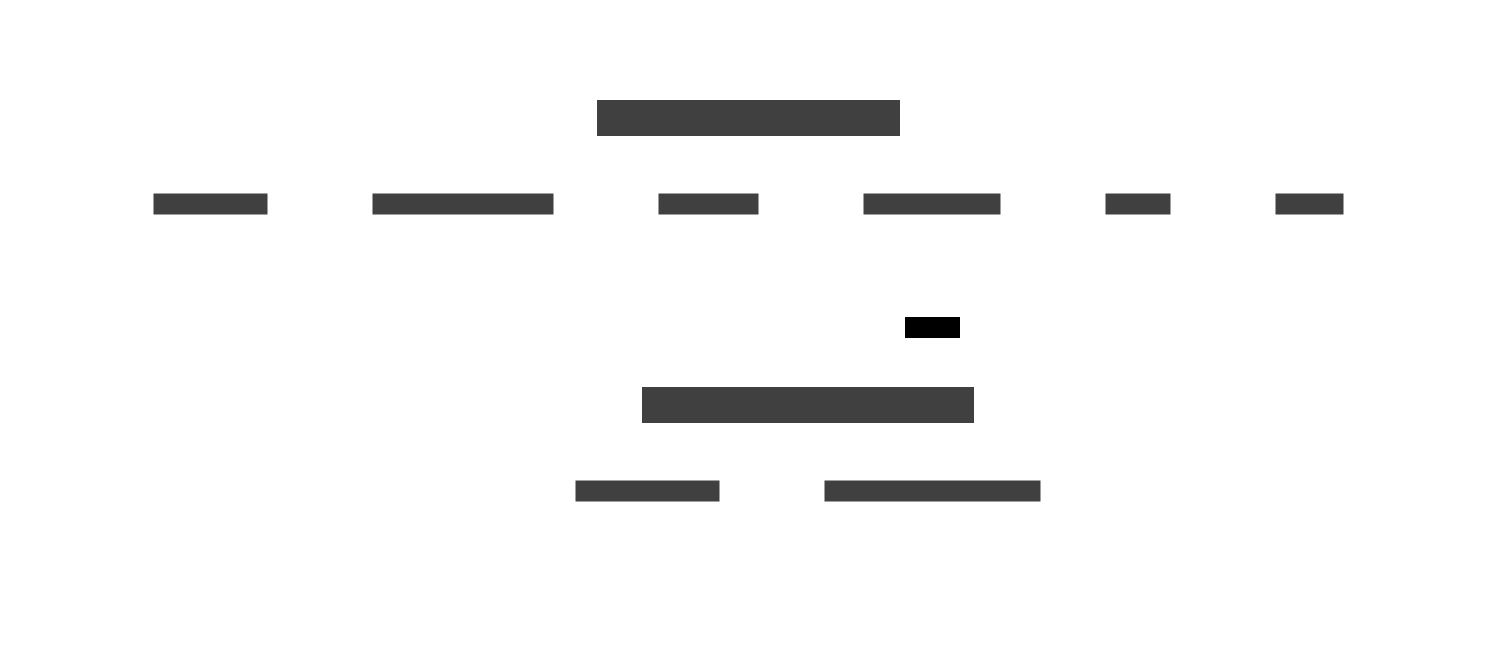
- No OAuth — BSV keypair signatures replace token-based auth entirely
- No payment processor — BSV transactions are the payment, atomic with work delivery
- No database for agent state — OP_RETURN is the audit log; BEAM process state is the working memory
- No orchestration SaaS — OTP supervision trees are the orchestration layer
- No vendor lock-in — any node with a Clojure REPL and a BSV wallet can join the swarm
The stack becomes reproducible from two dependencies:
clojure and a BSV node. That is it.
The Sovereignty Test
A useful way to think about this: can your agent swarm survive the death of every vendor you depend on?
- OpenAI goes down → your agents can route to any LLM provider. The model is swappable.
- Your cloud provider goes down → your BEAM cluster can run on any hardware. The runtime is portable.
- Your auth provider revokes your tokens → your agents have BSV keypairs. Identity is self-sovereign.
- Your payment processor freezes your account → your agents use BSV. Settlement is peer-to-peer.
This is not theoretical resilience. It is the logical outcome of choosing primitives over platforms. Platforms are optimised for the vendor’s business model. Primitives are owned by nobody and available to everyone.
What To Build First
If you are starting from scratch, the order that minimises risk and maximises learning:
Single Clojure/JVM agent with a BSV keypair — can sign messages, write to OP_RETURN, read contracts. No LLM yet. Prove the identity and ledger primitives work.
Add LLM tool calling — wire in an LLM client (Anthropic, local Ollama, whatever). The agent now reasons and acts.
Port to Clojerl on BEAM — same code, different runtime. Wrap in a GenServer. Add a supervisor. Your agent is now fault-tolerant.
Two agents, one hires the other — orchestrator writes a task contract to BSV; worker reads it, bonds a payment, executes, submits result hash, unlocks reward. This is the complete M2M economic primitive.
Swarm — multiple workers, supervision tree, task routing by capability. OP_RETURN becomes the discovery layer: agents advertise what they can do, orchestrators match tasks to bids.
Steps 1 and 2 you can do today with existing libraries. Step 3 requires Clojerl (experimental but functional). Steps 4 and 5 are the frontier — the glue layer that has not been built yet, but every component exists.
One Language. One Ledger.
The industry keeps adding layers — a new orchestration framework, a new identity standard, a new payment rails integration. Each layer solves one problem by introducing three new dependencies.
The insight that Clojure and BSV together make possible is this: the same data structure — an immutable, persistent map — can represent agent state in memory, a message on the wire, a record in a database, and a contract on a ledger. There is no translation layer. There is no impedance mismatch.
A Clojure map is a Clojure map whether it lives in a JVM heap, a BEAM process mailbox, a ClojureScript component, or serialised as data in an OP_RETURN output. BSV is an append-only store of such maps, globally accessible, cryptographically signed, economically settled.
That is the complete picture. One language that runs everywhere. One ledger that remembers everything. Agents that can think, act, prove, and pay — without asking anyone’s permission.